AEO vs SEO: What's the Difference, and Why Both Matter
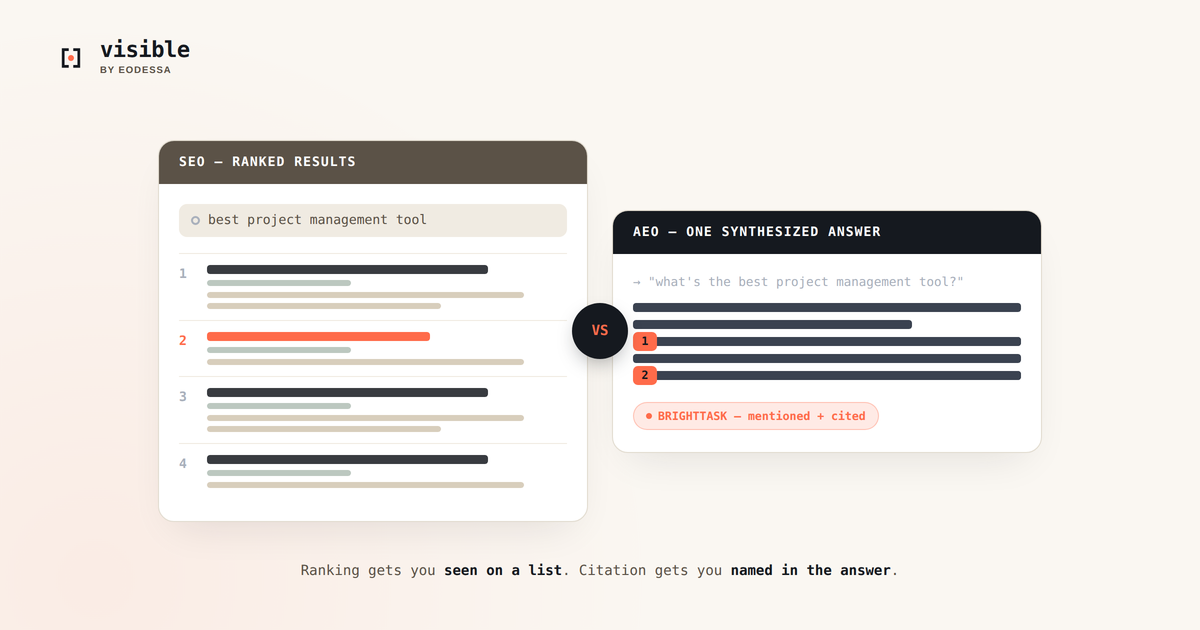
SEO and AEO solve two different problems that happen to use a lot of the same raw materials. SEO gets your page ranked on a results page that someone scans and clicks through. AEO gets your brand mentioned and cited inside an AI assistant's synthesized answer, where there's no ranked list at all — just one response that includes some sources and quietly omits the rest.
The fork in the road: a ranked list vs. one answer
Type a question into Google and you get a page of results, ranked, that you scan and choose from. Type the same question into ChatGPT, Claude, or Perplexity and you get one written answer that has already done the choosing for you. It might name two or three brands and link to a handful of sources. Everyone else who would have appeared somewhere on that Google results page simply isn't mentioned.
That's the entire reason AEO exists as something distinct from SEO. Ranking #4 on Google still gets you seen. Being the brand an AI assistant didn't choose to mention gets you nothing — no impression, no click, no chance.
Defining the two terms plainly
| SEO | AEO | |
|---|---|---|
| Optimizes for | Ranking position on a search results page | Being mentioned and cited inside an AI-generated answer |
| The user sees | A list of ranked links to choose from | One synthesized response with a few sources |
| Success looks like | Page one, top positions, strong click-through rate | Your brand named, your domain cited, mentioned early in the answer |
| Key inputs | Backlinks, keywords, page speed, crawlability | Clear facts, structured data, definitional content, entity clarity |
| Measured by | Rank tracking tools, Search Console | Sampling AI assistants' answers over time for mentions and citations |
Where they overlap — more than you'd think
AEO isn't a replacement discipline built from scratch. Most AI assistants ground their answers in live web search, so a lot of what makes a page rankable also makes it citable: clear writing, real authority, a crawlable site, and content that actually answers the question asked. If your SEO fundamentals are weak — thin content, broken crawling, no clear topic focus — your AEO will be weak too, because the AI is often pulling from the same indexed web your SEO work targets.
Good SEO is close to a prerequisite for good AEO. But it isn't sufficient on its own — which is the part most teams miss.
Where they diverge — and this is the part that catches people out
A page can do everything right for Google and still be skipped by an AI assistant. The two most common reasons:
- Vague facts vs. declarative facts. SEO rewards keyword-rich, persuasive copy. AEO rewards plain, extractable statements. "Our process is designed around exceptional customer outcomes" ranks fine and gets cited never. "Our standard turnaround is 3 business days" is the sentence an AI assistant can lift and attribute to you.
- No structured data. Search engines can often infer structure from well-written HTML. AI assistants lean much more heavily on explicit schema — FAQ markup, Organization data, clear headings — because it removes the ambiguity of "is this actually a fact about this entity, or just nearby text?"
- One answer, not ten results. SEO has room for ten good answers, so a page in position #7 still gets some traffic. AEO often has room for two or three. The bar to be included is functionally higher even when the content quality is comparable.
A simple way to think about it
SEO asks: "is this page good enough to rank?" AEO asks: "is this page good enough that an AI summarizing the topic would choose to quote and credit it, out of everything else it could have chosen?" The second bar is about being the clearest, most citable source on the specific fact being asked — not just a relevant, well-optimized page.
Key takeaway
SEO and AEO aren't competing strategies — they're two different finish lines that share most of the same training. Do your SEO fundamentals well, then go further: state your facts plainly, add structured data, and write the kind of clear, self-contained answer an AI assistant would feel confident quoting.
How to act on this
- Keep your SEO fundamentals solid. Crawlability, indexability, clean metadata, real content — none of that goes away.
- Add the AEO layer on top. Structured data, FAQ-style sections, and plainly stated facts on your most important pages.
- Find out where you actually stand. A deep scan checks both layers on your real site and tells you what to fix first, instead of guessing.
- Track whether it's working. AI search visibility tracking shows whether AI assistants are actually mentioning and citing you more over time — the only way to know your AEO work is paying off.
Frequently asked questions
Answer Engine Optimization — making content easy for AI assistants like ChatGPT, Claude, Gemini, and Perplexity to extract, understand, and cite directly in their answers.
No. SEO determines whether your page is crawled, indexed, and ranked by search engines. AEO determines whether an AI assistant mentions and cites your brand inside a synthesized answer. Both matter, because people use search engines and AI assistants for different things, often interchangeably.
SEO optimizes for rank position on a results page the user scans. AEO optimizes for being one of the few sources an AI assistant selects and cites inside a single answer, where most relevant pages are simply left out.
Yes. A page can rank on page one through backlinks and keyword targeting while stating its facts vaguely and carrying no structured data — making it hard for an AI assistant to extract and cite, even though it ranks well.
See where you stand on both
Get your AI Search Visibility Score across six AI assistants, free — and find out whether your AEO is keeping up with your SEO.
Check your visibility — free →